Best Lead Distribution Software in 2026: Pricing, Features, and Use Cases
 Anders Uhl
Updated November 6, 2026
Lead distribution software sits between the sources that produce leads and the buyers or branches that receive them. The choice depends on billing models, call features, buyer tools, and the workflow that produces revenue.
LeadExec combines ping-post, fixed-price buyer orders, a branded Client Portal, and published monthly and annual plan prices. Its free Starter account gives lead sellers a way to evaluate routing and buyer tools. ClickPoint Software compares LeadExec with Boberdoo, Lead Prosper, LeadsPedia, Phonexa LMS Sync, LeadByte, and Lead Distro AI against buyer workflow requirements.
What this comparison covers
Lead-selling workflows connect capture, validation, routing decisions, delivery to buyers, buyer management, billing, and reporting. Lead routing decides where a lead goes, and lead distribution sends it there. This selection focuses on software for businesses that sell leads to external buyers. Internal routing emphasizes territory, capacity, and delivery rules.
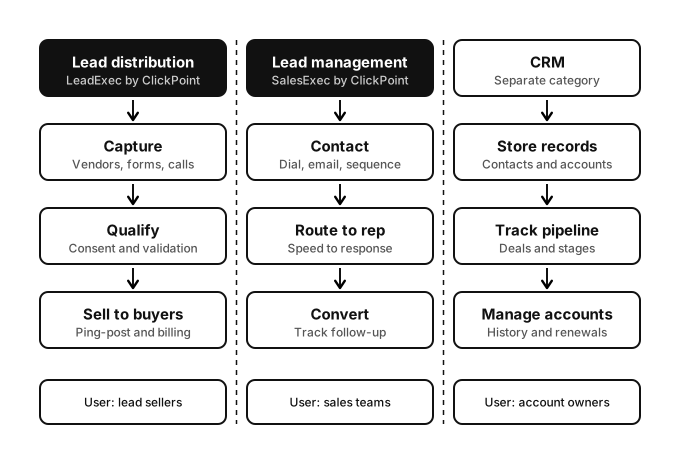
ClickPoint Software publishes the ClickPoint blog and develops LeadExec, one of the seven platforms compared. Every platform, LeadExec included, faced the same standard: claims come from the vendor's own public pages, read on November 5, 2026. What is lead distribution software explains the category itself. Product categories share routing functions. SalesExec, for example, is lead management software for contact center sales teams with pull-based lead distribution, a power dialer, and SMS and email nurture. Primary purpose and workflow depth guide this selection of lead-selling platforms.
Lead distribution software compared
LeadExec pairs published plan prices and included lead and ping allowances with a free Starter account for evaluation. LeadsPedia, Lead Prosper, and Lead Distro AI also publish plan prices with included usage. Boberdoo prices daily inbound actions, while Phonexa and LeadByte provide quotes. Each product card includes the vendor sources for its capabilities and pricing.
How the evaluation worked
ClickPoint's evaluation framework uses six criteria: intended use, routing, buyer operations, pricing basis, documented limitations, and source evidence. Each criterion corresponds to a field in the product cards. The evaluation draws on vendor pricing pages, product pages, and help articles read on November 5, 2026. Workflow fit determines the recommendations.
The profiles compare vendor documentation and public prices. Performance comparisons require separate hands-on trials under the same workloads and buyer conditions. A feature absent from the pages reviewed appears as "undocumented on the pages reviewed," a narrower statement than "unavailable." Prices reflect public list rates on the check date.
Seven lead distribution platform profiles
Each profile follows the same order: identity and fit, three or four documented capabilities, pricing with its verification date, one documented tradeoff, and the evidence links. LeadExec appears first because ClickPoint Software publishes the ClickPoint blog and develops LeadExec. The remaining six profiles follow with comparable depth, the same section order, and the same sourcing standard for every vendor.

LeadExec by ClickPoint Software
LeadExec is lead distribution software for lead sellers and enterprise organizations distributing leads internally. ClickPoint Software develops it, and lead sellers use it to sell leads to external buyers through ping-post and fixed-price orders.
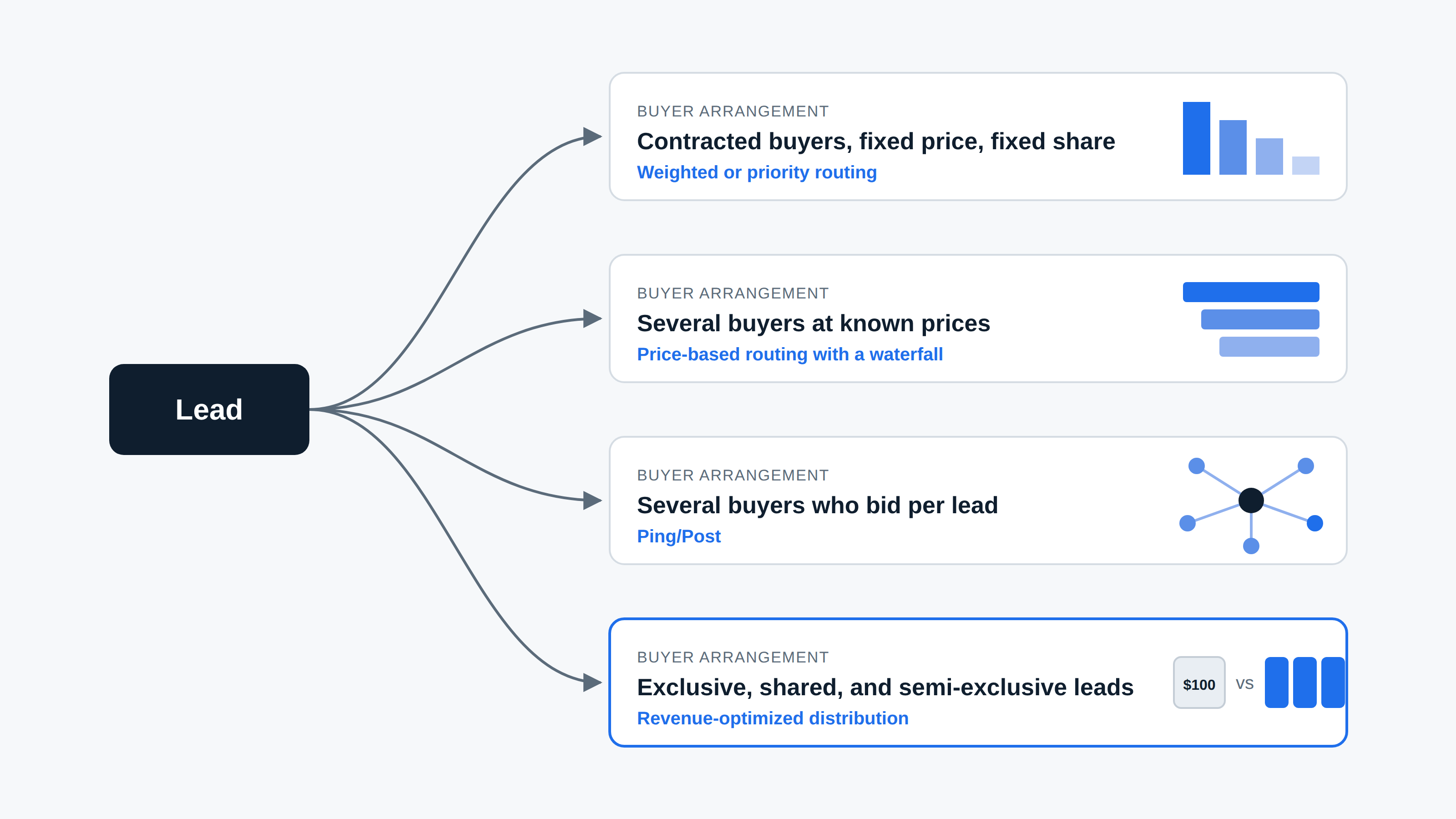
LeadExec supports price-based, priority, weighted, percentage, and round-robin distribution, plus waterfall routing, concurrent delivery, geographic routing, and real-time ping-post bidding. Revenue Optimization compares exclusive, shared, and semi-exclusive scenarios and selects the one with greater combined revenue, such as three semi-exclusive buyers at $40 ($120) over one exclusive buyer at $100. After a rejection, timeout, or delivery error, LeadExec can retry, continue down a waterfall, route to another buyer, or send the lead to Quality Control. Buyers manage orders, invoices, payments, and returns in the branded Client Portal, with Stripe and Authorize.net integrations for payment collection.
LeadExec pricing, verified November 5, 2026: Starter is free with no expiration and includes 250 leads and 10,000 pings a month. Growth costs $825/mo billed monthly or $660/mo billed annually, with 10,000 leads and 100,000 pings. Agency costs $1,650/mo or $1,320/mo billed annually, with 50,000 leads. Premium costs $2,500/mo or $2,000/mo billed annually, with 100,000 leads.
LeadExec tradeoff: Starter pauses lead receipt at 250 leads a month.
LeadExec evidence: pricing, routing, product page, plan guide.

Boberdoo
Boberdoo, from boberdoo.com LLC, describes itself as lead distribution, ping-post, and call routing software and dates its lead distribution work to 2001. It serves companies that buy and sell leads, calls, and clicks.
Boberdoo documents multiple distribution logic variations, unique filtering options for each buyer, and multiple billing options with automated invoicing on the pages reviewed. Its lead distribution page describes real-time optimization that chooses between exclusive and shared sale for a higher combined payout, plus post-rejection recovery that finds the next match after a buyer declines. Call routing covers standard and smart routing, live transfers, and ping-post for calls.
Boberdoo pricing, verified November 5, 2026: one monthly fee set by average daily inbound actions, meaning pings, posts, API calls, phone calls, and form loads. Outbound actions stay uncounted. Tiers run from $1,075 a month at up to 25 actions a day to $11,375 at up to 8 million, with the same features on every tier. Setup costs $250 once, and terms run month to month. A ramp-up promotion offers three months of unlimited volume at $500 a month.
Boberdoo tradeoff: call routing and lead delivery SMS run on the customer's own Twilio account, with minutes and numbers paid to Twilio directly.
Boberdoo evidence: pricing, solutions, lead distribution, company history.

Lead Prosper
Lead Prosper, based in Asheville, North Carolina, sells lead distribution software to lead sellers, lead buyers, and lead brokers. Campaigns form its core structure, connecting suppliers, buyers, filters, pricing, and caps.
Direct Post campaigns offer six distribution methods: waterfall, highest bidder, send to all, round robin, weighted round robin, and buyer groups. Ping Post Exchange campaigns run real-time auctions for exclusive or shared leads. Validation includes field filters, API filters, duplicate checks, and a pre-ping duplicate checker, plus one-click third-party services such as Anura and Xverify. On the pages reviewed, Lead Prosper's Customer Portal supports lead viewing, analytics, return requests, and configured Stripe payments. Its Supplier Portal gives lead sources access to lead data, performance reports, and exports.
Lead Prosper pricing, verified November 5, 2026: plans start at $500 a month with 5,000 leads, 200,000 pings, and 200,000 pre-pings included. Lead overage runs $0.05 per lead from 5,000 to 10,000, $0.02 from 10,000 to 50,000, and $0.015 from 50,000 to 100,000. Lead Prosper counts a lead at ingestion and a ping when a supplier sends one in, and outbound traffic carries zero charge. Plans carry zero contract commitment and cancel anytime. The Operate service adds Lead Prosper's team from $1,000 a month.
Lead Prosper tradeoff: the pages reviewed leave call tracking and call routing undocumented, and leads enter campaigns through the API.
Lead Prosper evidence: pricing, campaign guide, features, portal guide.

LeadsPedia
LeadsPedia, Inc. sells a lead distribution and call tracking platform for performance marketers. It combines lead acquisition, lead distribution, call tracking, and call routing in one product line.
On the lead distribution page, LeadsPedia routes leads and calls on predefined criteria such as geographic location and quality. Geo-targeting covers county, state, ZIP code, and ZIP radius, with filters on any data point. Distribution settings include hourly, daily, weekly, and monthly caps, customizable delivery schedules, and budget and credit management. Call routing includes advanced call distribution and a customizable IVR. The lead distribution page also lists real-time delivery and integrations with CRM systems and marketing tools.
LeadsPedia pricing, verified November 5, 2026: Lite costs $1,500 a month with 25,000 leads and 1,000,000 pings. Premium costs $2,500 a month with 100,000 leads and 5,000,000 pings. Enterprise uses custom annual pricing. Local numbers cost $3.00 on Lite and $1.50 on Premium, toll-free numbers $4.00 and $2.00, and minutes $0.055 and $0.045. Lite and Premium run on monthly terms with card billing.
LeadsPedia tradeoff: the pricing page leaves lead overage rates and setup fees undocumented, so Premium carries the only published price above 25,000 leads a month.
LeadsPedia evidence: pricing, lead distribution, home.

Phonexa LMS Sync
Phonexa Holdings LLC, based in Glendale, California, sells LMS Sync as its lead tracking and distribution product. LMS Sync sits in a suite with Call Logic for calls, E-Delivery for email and SMS, Books360 for accounting, and other products.
LMS Sync handles direct post and ping-post delivery, with custom distribution at the product, ping tree, and campaign level. Weighted bidding with bid multipliers sets winning criteria beyond price. Reports compare buyers and publishers by acceptance, payouts, and source. Buyer accounting settings support invoice frequency, due periods, auto-charge amounts, and lead-return controls when paired with Books360. The prepaid-buyer option requires activation on request with Books360.
Phonexa pricing, verified November 5, 2026: Phonexa provides package pricing through its sales team. The pricing page says pings and posts come with volumes that vary by package. Managed services come included, with a dedicated point of contact and up to four training sessions a month. Six product builds and 20 API builds come included, and each additional build costs $149.
Phonexa tradeoff: The Phonexa pricing page leaves package prices unpublished, and calls run through Call Logic, a separate suite product with minutes that vary by package.
Phonexa evidence: LMS Sync, pricing, buyer accounting, prepaid buyers.

LeadByte
LeadByte Limited, based in Chester, United Kingdom, describes LeadByte as a global lead management platform for lead generators, brands, and agencies. It packages the platform for lead sellers, lead buyers, and lead brokers.
LeadByte routes leads by waterfall, ping-post, round-robin, weighted percentage, or highest bidder, for exclusive or multi-sell leads, with hybrid groups that combine methods. Delivery runs through API, SMS, email, batch CSV, or FTP schedules. LeadByte's portal for buyers handles lead downloads, feedback, returns, and card payments, with language settings for buyers in other countries. Stripe processes buyer payments and automatic top-ups, and a supplier portal gives sources their own statistics.
LeadByte pricing, verified November 5, 2026: LeadByte lists three packages by audience and asks buyers to book a demo for prices. The pricing page lists zero setup fees, a 30-day rolling contract, and a money-back guarantee when LeadByte cannot meet a customer's needs after 30 days. Support carries zero cost, and a managed service is available.
LeadByte tradeoff: the pages reviewed leave call tracking and call routing undocumented, and human support runs Monday through Friday.
LeadByte evidence: features, pricing, home.
Lead Distro AI
Lead Distro AI sells a platform for lead gen agencies and pay-per-call networks. It captures, routes, and sells leads, calls, and appointments, and it bills each one.
Lead Distro AI sells each lead by ping-post, live bid, or rotation, and routes inbound calls through ring trees. On the Growth plan and above, a seller can run its own ring tree with live bids from its buyers on each call. Billing and payouts cover leads, calls, and appointments, with a Stripe billing integration, lead returns, and a Partner Portal that buyers use at zero seat cost.
Lead Distro AI pricing, verified November 5, 2026: Starter costs $297 a month with 2,500 leads, Growth $497 with 5,000 leads, and the next tier $997 with 15,000 leads. Enterprise uses custom pricing. Leads above the allowance cost $0.15 each on Starter, Growth, and the $997 tier, and pings carry zero metering on plans with ping-post. Annual billing saves roughly 17%. Every plan starts with a 7-day free trial that requires a card, with zero setup fee and month-to-month terms. Call usage adds $2 a month per local number, $3 per toll-free number, and $0.04 per local minute.
Lead Distro AI tradeoff: ping-post starts on Growth, and the $0.15 overage raises cost quickly above 15,000 leads.
Lead Distro AI evidence: pricing, home.
What lead distribution software costs
Lead distribution software costs depend on how each vendor counts usage: leads, pings, or inbound actions. At 5,000 web leads a month, published platform fees range from $497 to $1,500. At 50,000 leads, they range from $1,550 to $6,247. Phonexa and LeadByte require quotes. Setup, validation, call usage, and payment processing sit apart from those recurring platform fees.
The two cost scenarios are illustrative. Scenario A covers 5,000 inbound web leads a month from the seller's own forms, 10 active buyers, and ping-post to up to 10 eligible buyers per lead, for up to 50,000 outbound pings. Scenario B covers 50,000 leads, 40 active buyers, and the same ping pattern, for up to 500,000 outbound pings. Each lead arrives as one inbound post, and each product card uses the lowest published plan that meets those requirements.
Each conversion follows the vendor's published counting rule. LeadExec's plan guide notes that one inbound lead can produce multiple outbound pings, so Scenario B's 500,000 pings fit Agency's 1,000,000. Boberdoo counts inbound actions only: 167 a day in Scenario A and 1,667 in Scenario B over a 30-day month, and supplier pings before each post would move Scenario B to the $1,775 tier. Lead Prosper's Scenario B adds $250 and $800 in tiered lead overage to its $500 base. Lead Distro AI's Scenario B adds 35,000 leads at $0.15 to the $997 tier.
One-time and usage charges sit outside the table. LeadExec includes 4 setup hours on Growth and 6 on Agency, with extra hours from $155 an hour, and charges $0.02 per phone and email validation check, or $100 in Scenario A and $1,000 in Scenario B for one check per lead. Boberdoo charges $250 for setup, and Twilio bills its call minutes directly. Payment processor fees from Stripe or Authorize.net fall outside every figure.
A worked routing example
A typical exclusive-sale auction illustrates one ping-post configuration. This hypothetical case uses invented buyers and prices and follows one web lead from capture to a buyer response. Eligibility filters, buyer prices, and configured distribution rules determine selection. Shared-sale configurations can select multiple buyers. The operator needs a record of bids, responses, and delivery outcomes.
In the hypothetical example, an auto insurance lead arrives from a seller's own form in Arizona. Validation checks the phone and email formats and runs a duplicate check. The operator needs to see whether the lead passed, and the reason for any rejection or Quality Control hold.
In the hypothetical example, buyer filters then narrow 10 active buyers to four. Three buyers exclude Arizona, two have reached daily caps, and one sits outside its delivery schedule. The operator needs to see each excluded buyer and the filter, cap, or schedule that excluded it.
In the hypothetical example, the four eligible buyers receive a ping with partial lead data and bid $18, $20, $22, and $25. With price-ranked exclusive delivery configured, the full lead posts to the $25 buyer, which rejects it as a duplicate, and the waterfall moves to the $22 buyer, which accepts. The operator needs every bid, the rejection reason, the fallback step, the final price, and the lead source, so invoices and supplier payouts match the sale. LeadExec documents ping-post eligibility and pricing and configurable client sorting.
How to choose lead distribution software for each workflow
The choice of lead distribution software follows the workflow that produces revenue. Fixed-price selling needs buyer orders and caps. Ping-post auctions need bid handling and ping allowances. Shared leads need logic that compares exclusive and shared sale. Combined leads and calls need call routing and minute pricing. Internal distribution needs territory rules. Each workflow narrows the shortlist to platforms that document the required functions.
Fixed-price selling depends on buyer orders, caps, schedules, and invoicing. LeadExec documents buyer caps, delivery schedules, buyer orders, and invoicing. LeadsPedia and Lead Prosper document caps by time period.
Ping-post auctions depend on bid handling and on how each vendor charges for pings. Lead Prosper and Boberdoo leave outbound pings uncharged, and Lead Distro AI meters zero pings on plans with ping-post. LeadExec and LeadsPedia include a ping allowance in each plan.
Examples of documented exclusive-versus-shared comparison or multi-sell methods include LeadExec's Revenue Optimization and Boberdoo's real-time optimization, which both pick the sale with greater combined revenue. LeadByte supports multi-sell leads, and Lead Prosper offers a send-to-all method.
Combined leads and calls depend on call routing, number pricing, and minute rates. LeadExec documents direct call transfers and a drag-and-drop call flow designer. LeadsPedia and Lead Distro AI publish call pricing, Boberdoo runs calls on the customer's Twilio account, and Phonexa sells calls through Call Logic.
Internal distribution to branches depends on territory rules and capacity. LeadExec supports distribution to branches, franchises, dealers, and regional offices, with territory routing by state, ZIP code, postal code, county, DMA, region, or custom territory.
Questions to resolve before switching platforms
A platform switch moves live buyer revenue, so six questions need answers before cutover: how buyer integrations migrate, how routing rules translate, how returns carry over, where reporting history lives, what setup support covers, and how testing runs before launch. Each answer belongs in writing from the incoming vendor.
Buyer integration migration comes first. Each buyer's posting format, field mapping, and response parsing needs a rebuild and a test post. LeadExec's AI Assist onboarding guide describes guided buyer-profile creation and delivery setup, and Phonexa includes 20 API builds by its own team.
Routing rules need a written inventory before migration. Caps, schedules, filters, price tiers, and fallback order often live only in the current platform's settings, so the rebuilt rules need a side-by-side check.
Returns and reporting history need an export plan. Open returns, unpaid invoices, and past source performance stay in the current platform unless the team exports them.
Setup support differs by vendor. LeadExec includes 4 to 8 setup hours on paid plans, Boberdoo charges $195 an hour for custom work, Lead Prosper's Operate service starts at $1,000 a month, and Phonexa includes managed services.
Testing before cutover protects buyer relationships. A parallel run of test leads through every buyer endpoint confirms acceptance and rejection handling before live traffic moves.
Frequently asked questions
What is the best lead distribution software for a lead-selling business?
The answer depends on the workflow. Sellers that want ping-post, orders, invoicing, and buyer billing under published plan prices fit LeadExec. Call-heavy networks can compare LeadsPedia and Lead Distro AI, and teams that want managed services can request Phonexa quotes.
Which lead distribution platforms support ping-post?
All seven platforms document ping-post for selling leads to buyers. Each LeadExec plan, Starter included, lists a monthly ping allowance on the LeadExec pricing page.
Is the LeadExec Starter plan a free trial?
The LeadExec Starter plan is a free account with no expiration and no credit card requirement. Each month it covers 250 leads and 10,000 pings, and LeadExec pauses reception of further leads once a Starter account reaches 250 in a month. Create a free LeadExec account.
When should a buyer consider a platform other than LeadExec?
Teams that want setup support can weigh Phonexa's included managed services or Lead Prosper's Operate service. Operations that already pay Twilio directly for calls can compare Boberdoo, which routes calls through the customer's own Twilio account.
Which functions are native, integrated, separately purchased, or undocumented?
Routing, delivery, and portals for buyers appear as native functions on most platforms. Validation services, call minutes, and phone numbers usually carry usage charges, and Boberdoo's call routing depends on a separate Twilio account. Lead Prosper's and LeadByte's pages reviewed leave call routing undocumented.
Next step: compare LeadExec pricing and start a free account
LeadExec publishes four plans, from the free Starter account to Premium at $2,500/mo billed monthly or $2,000/mo billed annually, and the pricing page lists included leads, pings, setup hours, and usage rates for each plan. A free account lets a team run real leads through LeadExec and compare its routing and buyer tools against its own workflow requirements.
See LeadExec pricing and plans or create a free LeadExec account.